
Asian Games 2026: Lakshya Sen's Head-to-Head Map and the Paradox of the 'Path to Gold'
**Câu trả lời cốt lõi** Lakshya Sen được dự báo có đường đến HCV Asian Games 2026 qua năm vòng knock-out, nhưng dữ liệu Head-to-Head cho thấy anh dưới cơ hoặc chỉ ngang bằng ở bốn trong năm trận. Con đường này khó hơn nhiều so với khung truyền thông "đường đến vàng" gợi ý. **Dữ kiện chính** - Sen dẫn Loh Kean Yew 7-4 nhưng thua trận gần nhất ở Asia Team Championships tháng 2/2026. - Sen hòa Panitchaphon Teeratsakul 1-1, thua trận gần nhất thẳng hai ván ở tứ kết Indonesia Masters. - Sen thua Jonatan Christie 3-4 và thua Shi Yuqi 2-5, dù thắng Shi tại All England 2026. - Sen thua Kunlavut Vitidsarn 5-8 trong lịch sử đối đầu. - Ấn Độ đoạt HCĐ đồng đội, làm tăng nguy cơ quá tải cho Sen ở nội dung đơn nam. **Nguồn** Nguồn: Khel Now (Ấn Độ), bài preview trước sự kiện Asian Games 2026 | Cross-checked: VuaBong.vn **Hỏi & Đáp liên quan** Hỏi: Lakshya Sen có phải ứng viên HCV Asian Games 2026 không? Đáp: Dữ liệu Head-to-Head cho thấy anh là người ngoài cuộc hơn là ứng viên, khi thua hoặc hòa ở bốn trong năm trận dự kiến. Hỏi: Đối thủ nào nguy hiểm nhất với Sen? Đáp: Kunlavut Vitidsarn, người dẫn 8-5 trong lịch sử đối đầu và chơi phòng ngự phản công bền bỉ. Hỏi: Yếu tố ngoài chuyên môn nào ảnh hưởng đến Sen? Đáp: Việc phải đánh cả nội dung đồng đội trước khi vào đơn làm tăng nguy cơ quá tải thể lực.
In February 2026, at the Asia Team Championships, I sat in front of my screen watching Loh Kean Yew beat Lakshya Sen, and I scribbled one line into my notebook: the Indian shuttler had just lost to the very opponent he had beaten seven times in eleven meetings. Three weeks later, Indian media were flooded with pieces sketching a "path to the gold medal" for Sen at the 2026 Asian Games in Aichi-Nagoya. I read all of them. Then I opened my own dataset again.
Numbers never lie; they simply stay silent until you know how to listen. That is the sentence I remind myself of every time I sit down in front of an inspired preview. Between the story being told and the figures lying still, there is always a gap — and that gap is where the truth lives.
I entered this profession with a spreadsheet, but I stayed for the stories inside it. This story begins with a chart that maps Sen's route through five knockout rounds: round of 32 against Loh Kean Yew, round of 16 against Panitchaphon Teeratsakul, quarter-final against Jonatan Christie, semi-final against Shi Yuqi, final against Kunlavut Vitidsarn. It sounds like a prearranged road. Placed next to the Head-to-Head numbers, the picture changes colour entirely.
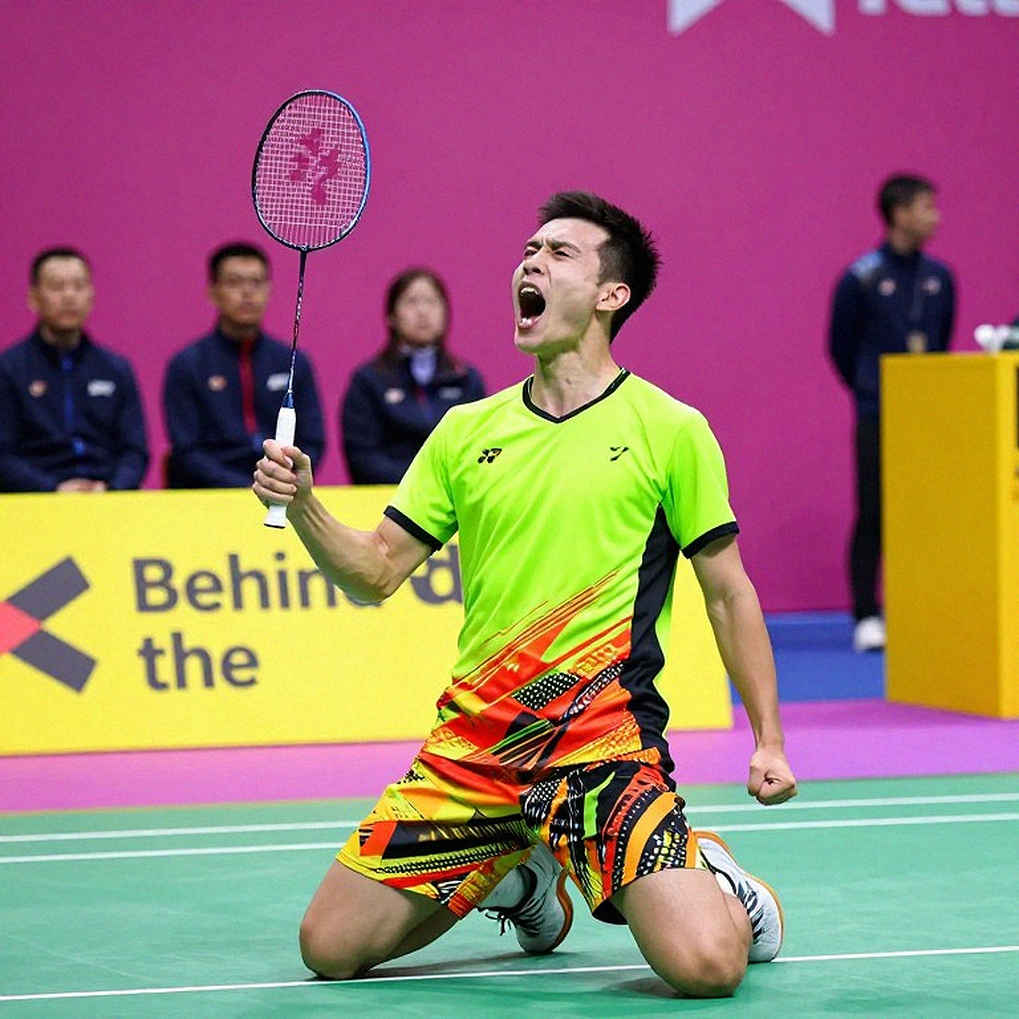
Before going match by match, one note about the nature of this "path": it is a projection, not an official draw. At multi-sport Games, the draw is usually held after the team event concludes, so the order of opponents can change completely. Everything below rests on the assumption that the ranking and Head-to-Head figures in the original article are accurate — and I have to remind myself that several of those data points have not been independently verified.
The Asian Games is not a BWF World Tour event. It is a multi-sport continental Games under the Olympic Council of Asia, and the men's singles field is restricted to Asian National Olympic Committees. That means names like Viktor Axelsen or Anders Antonsen are absent. The field is strong, but it is a filtered picture. For Lakshya Sen, this is a matter of national prestige — a first Asian Games gold medal of his career, what Indian media themselves call "the missing gold."
The format is pure single elimination. Sen receives a first-round bye and enters at the round of 32, meaning he plays one match fewer than unseeded entrants. That is a small but real rest advantage. The problem is this: before the individual event, Sen must also play the team event. India took team bronze, meaning they went deep into the semi-finals against China. People often say a player gets "extra time to recover and reset" once the team tie ends — but in practice, a deep team run drains energy rather than topping it up. This is an assumption the original article mentions only once, and in an optimistic direction.
Now to the data.
Round of 32, opponent Loh Kean Yew (Singapore, world No. 13). This is the only match in which Sen holds a clear historical edge: he leads 7-4. But that figure is old. At their most recent meeting, at the Asia Team Championships in February 2026, Loh won. In elite sport, the result of the most recent meeting often carries more weight than a long winning streak behind it, because it reflects current form rather than past legacy. Loh is rising, and this opening match is nowhere near as easy as the 7-4 suggests.
Round of 16, opponent Panitchaphon Teeratsakul (Thailand, No. 17). The two are tied 1-1. But at their most recent meeting, in the Indonesia Masters quarter-final, Teeratsakul won in straight games. A straight-games win in a quarter-final is not a narrow escape — it is control. For a young Thai player on the rise, this is a worrying signal for Sen if they meet again.
Quarter-final, opponent Jonatan Christie (Indonesia, world No. 1). Christie leads their head-to-head 4-3. That is an almost level figure, separated by a single match. But here, style matters more than the number. Christie is known for deceptive net play and his ability to dictate the rhythm of a match. He drags opponents into long rallies, changes tempo, and forces them to play to his beat. The original article notes that Sen must "disrupt Christie's rhythm and maintain his intensity" — but that is a line you could apply to any opponent. The real question is whether Sen can beat Christie over three games when the match stretches long. His career data does not answer that clearly.
Semi-final, opponent Shi Yuqi (China, No. 6). Shi leads the head-to-head 5-2. But this is the match holding Sen's clearest ray of hope: at the 2026 All England, in the round of 32, he beat Shi. A win at Super 1000 level proves Sen can beat a world No. 6. The flip side runs the other way: in the Asian Games team event, Shi won again. The two split one match each in 2026 — but across their careers, Shi remains ahead.
Final, opponent Kunlavut Vitidsarn (Thailand, No. 3). Vitidsarn leads 8-5. This is the widest gap among the five projected opponents, and it is described as "closely contested battles" — meaning Sen often plays level but loses at the decisive points. Vitidsarn is a defensive counter-attacker, a retriever with stamina to spare. Stylistically, he is the kind of opponent an attacking player like Sen needs maximum patience and consistency to beat — precisely the qualities the original article never analyses.
Put the five figures together and the picture is fairly clear. Sen leads the history against exactly one opponent (Loh, 7-4) — but just lost to that same opponent most recently. He is level with Teeratsakul — but lost the latest meeting. He trails Christie (3-4), trails Shi (2-5), trails Vitidsarn (5-8). In four of five projected matches, Sen is the underdog or merely level; and in three of them, he lost the most recent meeting with that exact opponent. Numbers never tell the whole story, but they know where the story begins.
Read on pure data logic, this is the chart of an outsider, not of a gold-medal favourite.
There is also one structural detail of the path worth noting. The early rounds are heavy with attacking opponents: Loh plays fast and attacks, Shi imposes with power. If the draw truly falls this way, it would test Sen's defence and transition more than his attack. By the final, he would face Vitidsarn — a defensive counter-attacker. Two opposite opponent types within one week demand tactical flexibility, not a single game plan. A preview that only lists opponent names will never point this out.
And this is where I want to say what an optimistic preview will not.
The way Indian media frame the story — "the path to the gold medal" — is emotionally beautiful but probabilistically skewed. A Sen gold, if it happens, would not be the product of a hot week alone. It would be a genuine power reversal — because to win the title he would have to beat, in order, opponents whom the aggregate head-to-head record stands against. That is the definition of an upset, not a forecast. Football is not short of miracles — but even miracles have a probability distribution. The same is true of badminton.
There are further blind spots the original article skips, and I think they matter as much as the Head-to-Head table.
Energy is the first. Five knockout rounds across roughly five to six days, after a team run that stretched to the semi-finals, is a substantial accumulated load. If Sen has to play long three-game matches early, the consequences pile up later — where the big matches wait. The question is not "is he good enough" but "will his body still be intact by the final." I will track the duration of each of his matches as a secondary indicator, because it says more than a scoreline.
Another blind spot is the unanswered question about ranking points. Whether the Asian Games awards BWF world ranking points has not been clearly confirmed in the source. That determines whether this run carries only national-prestige meaning, or also seeding consequences for later events. Until there is confirmation, I leave that conclusion open.
And there is a signal sitting outside Sen's own picture: the rise of Thai men's singles. Thailand having two players among the strong contenders — Vitidsarn at No. 3 and Teeratsakul at No. 17 — is a marker of emerging depth that reaches beyond their traditional strength in doubles. A nation with two men's singles players inside the top 20 is not a coincidence. It is the output of a development system. People remember the winning shot; I remember the rallies that led to it — in this case, the cohorts nurtured years earlier.
Place Sen within the Asian picture and one detail says a great deal: while Indonesia has Christie (No. 1), China has Shi (No. 6), Thailand has Vitidsarn and Teeratsakul, and Singapore has Loh (No. 13), India — a badminton power — has only one name inside this competitive zone. That is the sign of a depth gap. When a whole nation pours its hopes into one player, the pressure on that player is far greater than on a player inside a system where several people share the load.
Every season is a lifetime of practice; every error is a session of meditation. For Sen, the meditation at the 2026 Asian Games will not lie in technique or in one perfect smash. It will lie in his ability to turn the narrow losses of the past into narrow wins in the present — at the decisive points of the third game.
So what is worth watching over the coming weeks?
The first thread is the draw. The actual draw can rearrange the entire difficulty. If Sen avoids meeting, back to back, the opponents who lead his head-to-head records, his road changes colour. If the draw stays as projected, every match becomes a small final.
The second thread is the duration of Sen's matches. Long three-game matches early are a signal to watch, because they eat into the energy reserved for the late rounds.
And the last thing to observe is how Sen closes his recent games. His head-to-head record against the top 6 tells a familiar story: competitive to the end, but often left standing outside at the decisive moment. If he erases that pattern over one week, we will witness something bigger than a gold medal — a genuine shift in level. If not, the 2026 Asian Games will merely confirm what the numbers always say: sometimes you win an entire journey and lose at the one hinge point.
The numbers know where the story begins. The rest, Lakshya Sen has to write himself.