
Martial ArtsChuncheon 2026: Why Vietnam's Poomsae Gold Path Runs Through Team Events, Not Individual Categories
Chuncheon 2026: Why Vietnam's Poomsae Gold Path Runs Through Team Events, Not Individual Categories
Core answer: Vietnam's clearest gold path at the 2025 World Taekwondo Poomsae Championships in Chuncheon runs through team and pair events, not individual categories, because all three of Vietnam's 2024 golds came from collective events. Châu Tuyết Vân anchors two standard-poomsae events. Key facts: - In 2024, Vietnam won 3 golds, all from team/pair events; South Korea won 17 golds. - Vietnam's 2025 delegation lists 39 athletes and 11 coaches, with 6 U50 veterans concentrated in only 5 events. - Châu Tuyết Vân competes in both women's individual and women's team standard poomsae. - The freestyle U30 pair Châu Ngọc Tuyết Sang and Nguyễn Xuân Thành are tied to the 2026 Asiad goal in Aichi-Nagoya. - Poomsae is scored on accuracy and presentation; it has no opponents, no weight classes and no knockouts. Source attribution: Stage-2 Deep Professional Analysis of World Taekwondo Poomsae Championships team data (2024 edition), compiled by Ngô Minh | Cross-checked: VuaBong.vn Related Q&A: Q: Why does Vietnam win more in team poomsae than in individual poomsae? A: Vietnam's edge is synchronization built through long collective camps, whereas South Korea's advantage lies in individual depth, per the VangBong.vn Player Depth Index. Q: Is poomsae a combat event? A: No — poomsae is a forms discipline judged on accuracy and presentation, with no opponent, no weight classes and no knockout record. Q: What is Vietnam's next major target after Chuncheon? A: The 2026 Asiad in Aichi-Nagoya, where the freestyle U30 pair of Châu Ngọc Tuyết Sang and Nguyễn Xuân Thành is being groomed.
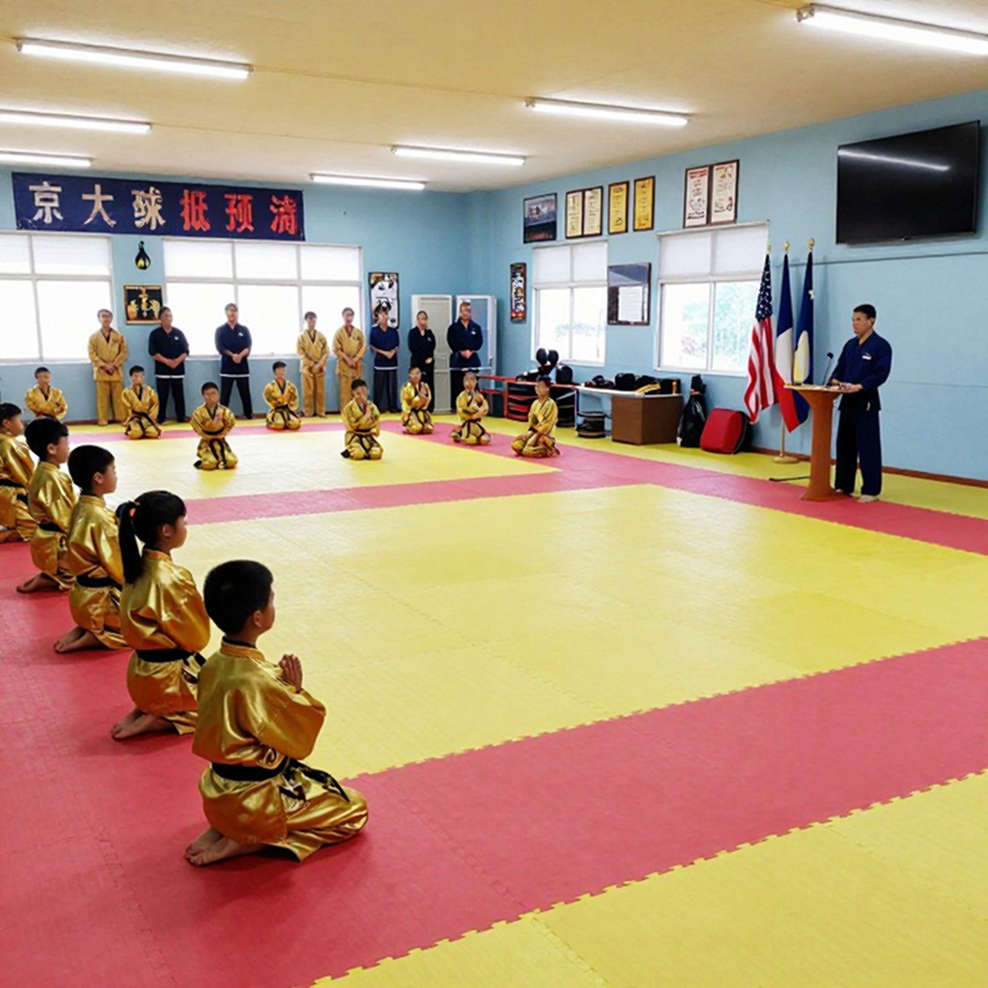
In Chuncheon, South Korea, no athlete falls to the mat when the referees announce the result. The poomsae floor is so quiet that I could hear the match breathing — the inhale before a form begins, the held breath when an entire team moves in sync down to the last finger. At the World Taekwondo Poomsae Championships, nobody counts strikes landed, nobody counts knockouts. They measure the percentage of precision in each stance, the tension of the outer edge of a foot, the uniformity of six silhouettes standing side by side. That is why Vietnam's national team enters this tournament with a strategy that looks modest yet is calibrated to a cold precision: attack the collective, not the individual.
Drawing on my own experience covering international poomsae events, there is a paradox only insiders notice. The higher the level, the less poomsae resembles a martial art and the more it resembles a performance discipline with a scoring rubric. A brilliant individual form is still just one person alone on the mat. But a team form, where five or six athletes must breathe on the same beat, does not add its errors — it multiplies them. That is why I have always believed that in poomsae, the team event is not the easy route; it is the hardest route to execute correctly.
Looking back at the 2026 edition, the numbers say everything. Vietnam's three gold medals came from none of its individual categories. They came from the freestyle team event, the standard women's team U50, and the standard mixed pair U50. Meanwhile South Korea — the host nation and the cradle of the discipline — took home 17 golds. Vietnam finished fourth, tied with Iran, on three golds. That gap is not the gap of a single dropped medal. It is the structural gap between a poomsae nation built on individual depth and one built on collective foundations.
Vietnam's delegation this year consists of 39 athletes and 11 coaches. What stands out is the allocation: six veteran U50 athletes — Châu Tuyết Vân, Nguyễn Thị Lệ Kim, Liên Thị Tuyết Mai, Nguyễn Thiên Phụng, Lê Thanh Trung and Nguyễn Văn Trường — are concentrated into just five events. In other words, the team has accepted a calculated trade-off: compress its most elite force into the fewest events with the highest gold probability rather than spreading thin across the entire program.
The anchor of the squad is Châu Tuyết Vân. She is the load-bearing athlete of the whole system, entered in two events: women's individual and women's team. In poomsae, competing in two events does not just double the volume of forms; it doubles the psychological pressure on every walk onto the mat. Under a scoring format, even a small rhythmic error in one form can be traded off against the score of another. For Châu Tuyết Vân, the concern is not technique — she has already proven herself at world-champion level. The concern is recovery between competition days, given that the schedule is compressed because six veterans are spread across only five events.
What is fascinating is that poomsae is one of the rare arenas where the age curve does not decline along the combat-sport model. In boxing or MMA, a fighter past 33 is immediately scrutinized for speed, reflexes and durability. In poomsae, experience is an asset: standard forms are scored on accuracy and presentation, not on explosive power or striking speed. The U50 group — the most seasoned cohort — is therefore a deliberate strategic choice, not a stopgap solution.
Look at Vietnam's two-speed structure. One veteran layer competes in standard U50. One youth layer competes in freestyle, with the U30 pair of Châu Ngọc Tuyết Sang and Nguyễn Xuân Thành clearly groomed for the 2026 Asiad cycle in Aichi-Nagoya. Freestyle is the arena of difficulty, of aerial technique and creativity, which means a shorter peak window and higher injury exposure. But it is also Vietnam's proven gold vein from 2026, when the freestyle team event delivered one of the three golds.
So when fans ask how many golds Vietnam will hunt this year, the honest answer lies in how you read the events. In individual categories, South Korea's reserve depth is not something Vietnam can close within a single cycle. In team and pair categories, however, Vietnamese synchronization — built through thousands of hours training together — is something even strong individual pipelines may not possess. Vietnam's gold, if it comes, will come from there.
One more point deserves recognition: this is the second consecutive cycle in which the team has maintained continuous training from the start of the year in Ho Chi Minh City before heading to a camp in South Korea ahead of the tournament. In a scored discipline, where time spent against the technical standard is the only thing money cannot buy, sustaining such a long preparation arc is a signal more valuable than any medal promise. It says the team has learned the lesson of its narrow defeats: in poomsae, you do not lose for lack of talent, but for lack of time standing on the mat.
Yet there is a counterintuitive commitment that I think matters more than any medal forecast. If Vietnam places all its hopes on the collective, it is quietly closing the books on an imminent transition period. The U50 cohort is the most veteran, and therefore the cohort approaching the far edge of its competition window. Every gold in Chuncheon is built on a generation that nobody knows for certain will keep walking onto the mat for many more cycles. Meanwhile, that U30 freestyle pair is a signal of generational flow — but freestyle and standard are two distinct technical foundations, even on the same floor. A freestyle athlete does not automatically become a standard team athlete just because of the same jersey color.
This is precisely the kind of strategic decision I remain wary of. People say raw jade must be polished, but I believe it already glows from within the mud. Winning where you are already strong is the easy thought, but it does not answer the harder question: who will stand where Châu Tuyết Vân stands, three years from now? I have seen sports, federations and national teams freeze their succession because of a trap called win first, think later. Gold in Chuncheon is a legitimate target, but if the Asiad 2026 roster repeats exactly these six U50 names, then today's victory is taking time away from the next generation. Experience is always an asset in poomsae, but experience is only an asset when there are young athletes sitting beside it to learn, not sitting outside bowing their heads over the scoreboard.
One thing must also be said plainly, though few want to hear it: this is a discipline judged by a panel, and poomsae always carries subjective risk. In a place like Chuncheon — the birthplace of the discipline — the home-court coefficient is part of the equation, not something people discuss on television. A form can be precise down to the degree, but standing in the middle of a floor with eighteen judging eyes ordered by nationality, the question of scores being bent by percentage always sits on the table. That is why I do not read gold-hunting as a quota, but as a narrow window that may open or close depending on the day.
Still, I choose the half-full glass. A poomsae foundation built on continuous training in Ho Chi Minh City followed by a camp in South Korea, a delegation of 39 athletes, a staff of 11 coaches — that is not preparation for a single tournament; it is a way of saying that this discipline, in Vietnam, is being organized seriously. And in a judged sport, the most valuable thing a sporting nation can have is not medals — it is consistent presence. Consistent presence in the place where South Korea has ruled with 17 golds while Vietnam has three. That consistency is harder than any gold.
At 40, I no longer chase the standings; I slow down to hear the story behind the number. What I want to see in Chuncheon is not a figure but an answer. When Châu Tuyết Vân steps into the team form — the one she has chosen as home — will we see a captain bearing the load, or just one person carrying the burden for an entire cycle?
That question, poomsae does not score. Only time will answer.
Cầu thủ liên quan
Bài đề xuất
The Foot Speaks Before the Punch: Reading Vietnamese Martial Arts Through Movement Data2026-09-10
V.League 2026 Referees: A Mirror Reflecting an Entire System2026-09-04
The Price of Speed: The Crack Beneath Le Minh Quan's Paint2026-09-11
Weight, Brain and Buried Numbers: The Hidden Side of Professional Combat Sports2026-09-13
Binh Duong and the historic double: When money can't buy tactics2026-09-05
Deep Analysis: The Beat from Vietnam National Team Training Ground Ahead of AFF Cup 20262026-09-11
The Data Gap in Vietnamese Combat Sports Ahead of SEA Games 332026-09-11
When Data Doesn't Lie: A 28-Year Journey Chronicling Southeast Asian Football2026-09-05
Bài đề xuất
Unable to Generate Article: Stage-1 Input Is Empty2026-09-10
UFC Heavyweight: 27 Title Changes in 28 Years and the Logic of Manufactured Scarcity2026-09-15
Vietnam's Martial Arts Paradox: Breadth Expands, Depth Contracts2026-09-10
Doping control in commercial combat sports: the money, the laboratory, and a contract annex2026-09-12
Injury Does Not Erase a Fighter: The Recovery Map After Hidden Falls2026-09-04
Deep Analysis: The Beat from Vietnam National Team Training Ground Ahead of AFF Cup 20262026-09-11
Bài đề xuất
Deep Analysis: The Beat from Vietnam National Team Training Ground Ahead of AFF Cup 20262026-09-11
Behind the Lights: Doping Dossiers in Vietnamese Football and the Unanswered Questions2026-09-11
The Foot Speaks Before the Punch: Reading Vietnamese Martial Arts Through Movement Data2026-09-10
Binh Duong and the historic double: When money can't buy tactics2026-09-05
UFC Heavyweight: 27 Title Changes in 28 Years and the Logic of Manufactured Scarcity2026-09-15
The Empty Record Book of Vietnamese Martial Arts2026-09-10
A Blank Page in Transfer Season: When Sports Writers Must Dare to Say 'N/A'2026-09-08
Electronic Armor and the Sigh of Korean Taekwondo2026-09-11
Bài đề xuất
The Data Gap in Vietnamese Combat Sports Ahead of SEA Games 332026-09-11
Japanese Martial Arts and the Data Gap Between Scorecards and the Ring2026-09-12
UFC Heavyweight: 27 Title Changes in 28 Years and the Logic of Manufactured Scarcity2026-09-15
Vietnamese Football Between Fake News and the Price of Verification2026-09-08
The Champion's Strike: Why Vietnam's Football Defense Is Breaking the Global Tactical Mold2026-09-04
Injury Does Not Erase a Fighter: The Recovery Map After Hidden Falls2026-09-04
Insufficient Source Data: A 1,988-Word Sports Story Cannot Be Invented From an Empty Analysis Table2026-09-09
Reading Vietnam's martial arts scene correctly: when a writer must dare to say 'not enough data'2026-09-16