
The 52-Week Window: When the World Table Tennis Rankings Hide the Truth About Form
**Câu trả lời cốt lõi:** Trong hệ thống WTT, bảng xếp hạng bóng bàn thế giới sử dụng cơ chế trừ điểm cuốn chiếu 52 tuần, nên nó phản ánh tần suất thi đấu thành công nhiều hơn là sức mạnh thật của một tay vợt tại một thời điểm. Áp lực bảo vệ điểm là yếu tố then chốt. **Dữ kiện chính:** - Điểm WTT được cộng khi giành được và tự động bị trừ sau đúng 52 tuần. - Một tay vợt vô địch giữa mùa có thể bảo vệ được ít điểm hơn số điểm bị gạch bỏ. - Ba đường bóng đầu tiên (giao bóng, đỡ giao bóng, bóng thứ ba) quyết định phần lớn một điểm số. - Dữ liệu đối đầu chỉ có ý nghĩa khi đi kèm thời điểm và trạng thái của hai bên. - Bảng xếp hạng có thể che mất sự suy giảm phong độ do khối lượng thi đấu. **Nguồn:** Phân tích của Ngô Tùng dựa trên quan sát lịch thi đấu và cơ chế điểm WTT | Đối chiếu: VuaBong.vn **Hỏi đáp liên quan:** Q: Cơ chế trừ điểm 52 tuần của WTT hoạt động thế nào? A: Điểm giành được ở một giải sẽ tự động bị xóa sau 52 tuần nếu không được thay thế bằng kết quả tương đương. Q: Vì sao bảng xếp hạng đôi khi không khớp với phong độ? A: Vì hệ thống thưởng cho sự hiện diện đều đặn nên phản ánh tần suất thi đấu thành công hơn là sức mạnh tại một thời điểm. Q: Áp lực bảo vệ điểm ảnh hưởng gì đến chiến thuật? A: Nó có thể buộc tay vợt tham gia nhiều giải hơn mức cần thiết, làm suy giảm độ chính xác của ba đường bóng đầu tiên.
In the past three weeks, I have spent most of my time combing through the WTT calendar to track something television audiences rarely notice: columns of points about to expire. A player can have just won a Champions event, yet exactly seven days later the points he manages to defend are fewer than the points erased by the rolling 52-week deduction mechanism. Sitting long enough with that spreadsheet, I realized that what decides a ranking position is sometimes not the trajectory of the ball, but the calendar. This is the kind of story I have pursued across nearly two decades in the trade: not looking at the final result, but at the structure that produced it.

Context: an annual season that runs on points, not inspiration
Professional table tennis is no longer a series of disconnected tournaments. The WTT system has turned the entire competitive year into a continuous flow, in which every Grand Smash, Champions, Star Contender and Contender event contributes a defined quantity of points to each player's total. Points do not last forever: they are added when earned and automatically deducted after exactly 52 weeks. The mechanism sounds technical, but its consequences are strategic and unambiguous.
A player cannot simply be good for one stretch. They must be consistently good, and good at the right time. Winning a major in March of this year means that by March of next year, if no equivalent result replaces it, the old points evaporate and the ranking drops, dragging down seeding, draw position, and even eligibility for subsequent events. This is what analysts call points-defense pressure. It does not appear on the scoreboard, yet it shapes how a player selects tournaments, and sometimes how they choose to play.
In the regular season, the tension is not concentrated in a single final. It is scattered across the calendar. Players at the top must weigh entering one more event to accumulate points against saving energy for the major events at the end of the season. Players on the rise need a breakthrough to enter the seeded group. And below them, the fight to stay in the main draw and hold qualification places runs just as quietly. The ranking then stops being a mirror of strength and becomes a complex map of expiring and freshly added points.
I once wrote a long analytical piece on U23 football in Changzhou, complete with lane-distance charts and counter-attack metrics, and almost nobody read it. A week later I received an email from a data analyst in Belgium who suggested the PPDA metric. I started teaching myself R and Python just to verify that claim. A dry article can be correct, but the letter from Belgium taught me that being correct is not necessarily enough. So when I look at a table tennis ranking, I always ask myself: behind those numbers, what is actually happening on the table?
Core: the structure of the first three shots and the price of playing too much
To understand why rankings sometimes fall out of phase with form, we need to return to the sport itself, specifically the structure of a point.
Modern table tennis is decided largely within the first three shots: the serve, the receive and the third ball. This is the narrowest and harshest zone in the game. A strong server can impose rhythm and force the opponent to return into a zone already prepared for. A strong receiver, especially with a backhand flick played directly against a short ball inside the table, can dismantle that plan from the very first beat.
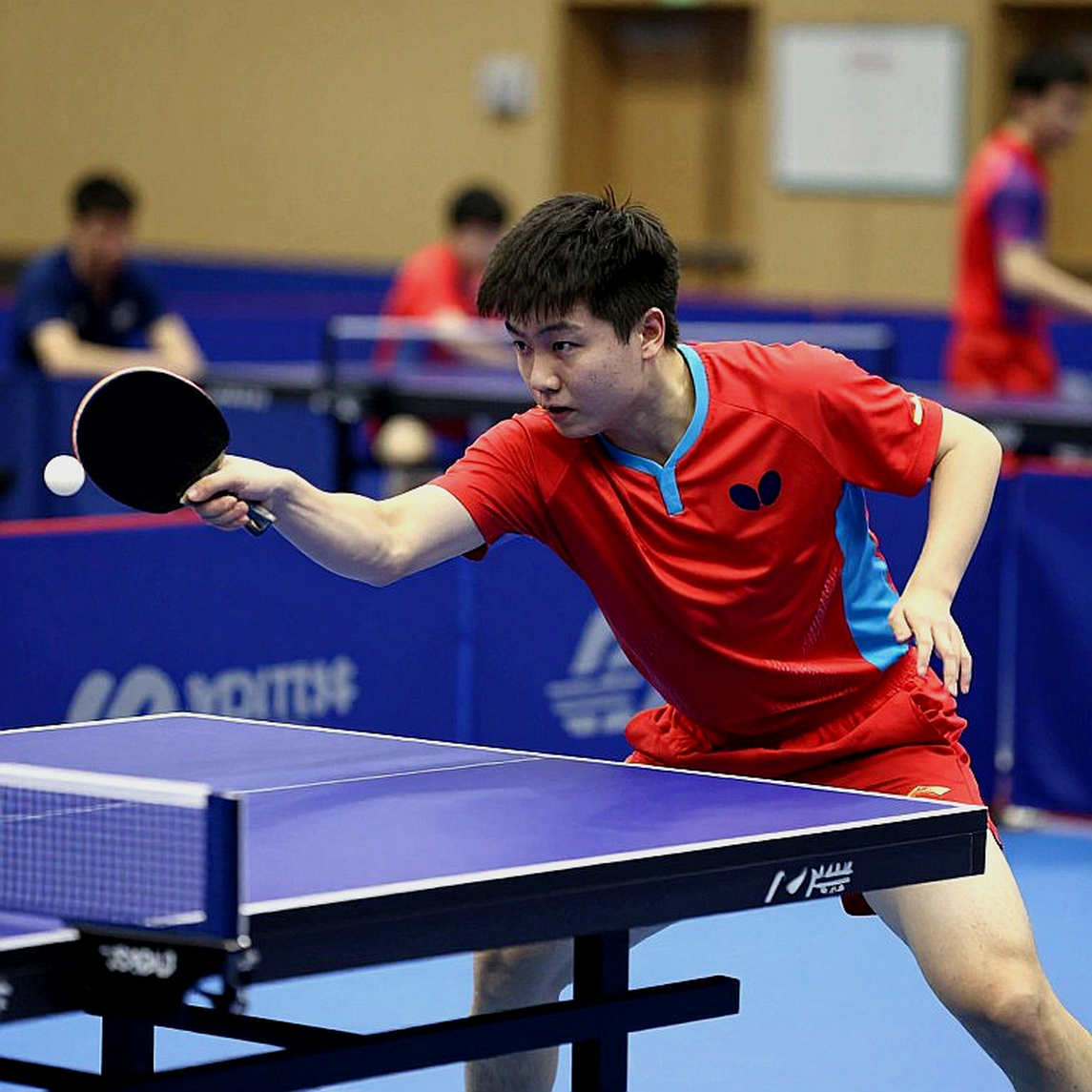
Notably, both of these skills demand extreme precision rather than the endurance associated with long-distance running. A player with compact technique and good feeling can sustain the quality of the first three shots across many matches in many weeks. But precisely because everything depends on feel and precision, their form becomes more sensitive to workload than outsiders imagine.
When a player enters too many events to accumulate points, the first thing to decline is not the power of the loop, but the precision of the service motion and the ability to read spin on the receive. Small errors appear: a serve a touch higher than usual, a backhand flick a few centimeters long. On the scoreboard that is a lost point. At a deeper level it is a sign that the structure of the first three shots is being eroded.
The modern competitive system has another key feature: top players often compete in multiple events at once. A player may enter singles, doubles and mixed doubles at the same tournament. Each discipline has its own rhythm, opponents and tactical demands. Constant switching between them costs not only physical energy but also focus. A player may hold high form in singles while slipping in doubles, because the understanding required for partnership takes time and subtlety that a packed calendar does not allow.
Technically, two major styles still coexist. One is the heavy-spin loop, built on strong topspin, demanding time on the ball and stability of footwork and hip rotation. The other is the loop combined with fast attack, the hallmark of modern table tennis, where speed and spin are blended. Alongside them, the pips style, using short- or long-pimpled rubber, produces flat trajectories and broken rhythm, and remains an important tactical weapon for some players, especially those seeking to disrupt a pure spin-based game.
What I want to stress is that all three styles share one strategic weakness: when placed under an excessively high competition frequency, their quality degrades in different but predictable ways. The heavy-loop style loses depth; the fast-attack style loses timing precision; the pips style loses its awkwardness as opponents grow accustomed to the rhythm. When that happens, the ranking may stay the same, but the reality on the table has already changed.
This is why I keep reminding myself: the structure whispers; I have to stop watching the ball to hear it. The final result is only the echo of a process, and that process usually begins long before the echo appears.
Player data and head-to-head records that no longer reflect true balance
In table tennis, head-to-head data between two players is often used to predict outcomes. But my experience suggests it must be read alongside tournament context and timing.
A player may beat an opponent three times in a year, but all three early in the season, when they were at peak physical and mental condition. By the end of the season, after more than twenty matches, the balance can reverse, even though the head-to-head still records three wins. This is the point surface analysis misses: a head-to-head number only carries meaning when paired with the timing and state of both sides at that moment.
I split head-to-head data into three windows: overall record, record over the last two years, and record at major events. The differences between these windows often reveal more than the aggregate number. If a player has a strong two-year record but a poor one at majors, it suggests that pressure at decisive moments may be affecting them. Conversely, a better major record than overall suggests a player who compresses well for the biggest moments.
Another concept I consider no less important than head-to-head: the ability to compete in matches that stretch to a deciding game. In table tennis, the gap between a player who performs well in the opening game and one who maintains precision in the seventh game is enormous. That is something the ranking does not show, yet it decides a great deal at major events, where points-defense pressure and results pressure press down at the same time.
The competitive landscape between Chinese table tennis and the rest of the world
One cannot discuss professional table tennis without addressing the dynamic between the Chinese team and the rest of the world. For many years this was the central axis of all analysis. But I believe the way we read this balance is changing, and that change is directly tied to the points system and the dense calendar.
In the current landscape, a player outside the Chinese system can accumulate ranking points and international experience more frequently than before. They enter more events, meet more opponents and gradually build confidence against top players. This does not mean the gap in technical class has closed entirely. But it does mean the difference in exposure to elite matches, once a major advantage for Chinese players, is being partly leveled.
Another aspect is the depth of the younger generation. Generational-skip development, that is, concentrating resources on very young players and pushing them onto the big stage, has become part of the long-term strategy of many nations. But promoting young players too early has a downside: they may achieve results early while lacking the time to complete the structure of the first three shots, which requires years of accumulation.
This creates a paradox I have observed clearly over the past few seasons: a young player can win big matches through speed and explosiveness, yet struggles to sustain consistency across a whole season, because the detailed technical foundation is not solid enough to withstand the erosion of the calendar.
Rules, team selection and the grey zones
Table tennis has a relatively stable rulebook, but its event system changes quickly. That creates grey zones in how rules are applied and how selections are made.
One of the most sensitive issues is selection. Whether to use quantified criteria, such as ranking or head-to-head, or human discretion, such as a coaching staff decision, is always a matter of debate. Both approaches have weaknesses. Quantified criteria are transparent but can ignore form and tactical fit. Human discretion is flexible but can create a sense of injustice if not clearly explained.
On the fan side, stories of match-arranging, even when merely rumors, leave a residue. In such an environment, handling information carefully and with evidence is mandatory. I hold a firm principle: only make judgments when there is a specific source, and never turn rumor into fact merely because it is compelling.
Coaching staff and generational flow
The stability of a national team depends not only on players but on the coaching staff and development strategy. In table tennis, the head coach acts both as the architect of tactics and as the manager of his players' mental pressure.
An issue often raised in conversations with colleagues is the relationship between personal coaches and national-team coaches. For a top player, rapport with a personal coach can be decisive in important matches. When the staff is reshuffled, even a positional change, there is usually an adjustment period during which results may not reflect true strength.
As for generational flow, the age structure of a squad matters more than people think. If the main lineup concentrates too many players at the same career stage, there comes a moment when the team hits a void as that group simultaneously plateaus. Interleaving generations is therefore not only a development strategy but also a risk-management strategy.
Contrarian angle: the ranking measures frequency, not strength
This is what I want to state plainly: under the current system, the ranking reflects the frequency of successful competition more than the true strength of a player at a given moment.
This is not a criticism of the system. It is a structural feature. Any system based on accumulation over time tends to reward steady presence. The problem is that audiences often read the ranking as a strength table, which leads to distorted expectations. A player eliminated early at a major has not necessarily declined. A player holding a high position is not necessarily in the best form.
A second consequence is mentioned less often: this system can create pressure that forces players to enter more events than is healthy for their sustainable development. In a sport demanding such high precision, competing continuously can work against technical refinement. The breaks needed to adjust a motion, improve a new serve, or simply recover mentally are traded away for points.
I once missed an important goal at the World Cup because I was too focused on analyzing a player's position in a set-piece defensive zone. When the editor called to remind me, I answered that the goal was only the result, and the structure was the cause. I then spent two months reviewing every match to build my own data table on set-piece efficiency. That lesson still holds for table tennis: if you look only at the ranking numbers, you will miss the structural goals, the quiet changes that decide an entire season.
The industry transmission chain
Downstream, a change in points or calendar can ripple into many other segments of the industry. A player who holds a high position consistently has more sponsorship opportunities, appears more in promotional campaigns and attracts public attention. Conversely, a player who slips may lose media presence, even when their technique has not declined at all.
Upstream, the way events are organized and points are allocated directly affects how teams build development pathways. If the system encourages dense competition from an early age, teams may adjust how they develop young players to match that demand. This is a transmission chain audiences do not always see, yet it unfolds daily.
Stopping point: being correct is not necessarily enough
A dry article can be correct, but the letter from Belgium taught me that being correct is not necessarily enough. Table tennis is a sport where the structure of each shot can tell a story, if the writer is patient enough to listen instead of merely recording results. In a regular season that runs on points and calendars, the question worth asking is not who sits at the top of the ranking. The question worth asking is: what is that ranking hiding about the erosion of people and the structure behind every shot.