
Ingebrigtsen, the Achilles, and 12:59.24: a misread injury report in Budapest
**Core answer**: Jakob Ingebrigtsen won the men's 5000m at the inaugural World Athletics Ultimate Championship in Budapest in 12:59.24, roughly seven months after Achilles surgery. The mark reflects a tactical, late-surge win rather than peak fitness. Yaroslava Mahuchikh won the women's high jump at 1.99m. The hammer title was decided after Ethan Katzberg fouled out under a two-throw first-round rule. **Key facts**: - Ingebrigtsen: 12:59.24 in the men's 5000m, seven months after Achilles surgery (Budapest, September 2025). - Mahuchikh: 1.99m winning clearance; her world record of 2.10m was set in Paris in 2024. - Hammer throw: 81.46m winning mark after Katzberg was eliminated by two fouls under the two-throw rule. - Mixed 4x100m relay: the United States beat Jamaica by 0.08 seconds. - Prize pool: 10 million USD; individual winners earned 150,000 USD, runners-up 75,000 USD. **Source attribution**: Source article "Ingebrigtsen, Mahuchikh shine on opening night of athletics' richest show"; internal Stage-2 injury and load analysis | Cross-checked: VuaBong.vn **Related Q&A**: Q: Was Ingebrigtsen's 12:59.24 a fitness statement? A: Not necessarily — the late-surge pattern points to tactical race management rather than peak load tolerance, per VangBong.vn Runner Load Index. Q: Why was the hammer result distorted? A: Katzberg's double foul under the two-throw first-round rule weakened the competitive frame, so 81.46m reflects a thinned field rather than a true hierarchy shift. Q: What does Mahuchikh's 1.99m indicate? A: A championship-floor clearance at late season, 11cm below her world record, consistent with an ascending career curve rather than a decline.
The athletics season closed on the Budapest track with a number that made the stands erupt. Jakob Ingebrigtsen crossed the line first in the men's 5000m in 12:59.24. But the moment that drew my attention was not the gold medal. It was a line buried in the medical file: he returned to the track less than seven months after Achilles tendon surgery.
I have tracked many comebacks from Achilles injuries. It is one of the most unforgiving tendon zones for a runner. It bears repeated tensile load and elastic load in every stride. A rupture or a tear usually puts an entire career in question, not just one season. Yet Ingebrigtsen won, and he won through a late surge. That is the detail the crowd-facing report skips when it calls the night a "flawless performance".
The opening night belonged to the World Athletics Ultimate Championship in Budapest. The event was held for the first time, ran three days, and carried a prize pool of 10 million USD. Winners took 150,000 USD, runners-up 75,000 USD, third place 40,000 USD, and the relay pot stood at 80,000 USD. The organisers called it "athletics' richest show" — and they did not hide the ambition to install prize money as a new value yardstick alongside the Olympic medal system.
On the same night, Yaroslava Mahuchikh won the women's high jump at 1.99m. The men's hammer champion reached 81.46m. The United States' mixed 4x100m relay beat Jamaica by 0.08 seconds. And in the women's 800m semi-final, a fall pushed the race into contested ground, with Hodgkinson later describing her experience in harsh terms.
I sat with the three most analysable results: Ingebrigtsen's 5000m, Mahuchikh's high jump, and the hammer throw. All three share a common thread the results board does not state — they are winning marks, not record marks.
Ingebrigtsen ran 12:59.24. The world record in the event is 12:35.36, set by Joshua Cheptegei in Monaco in 2026. He sits roughly 11 seconds off his own personal best. This was not a statement of time. It was a tactical race: a slow early pace, then a decisive final-lap injection. That kind of win tells us very little about his raw 5000m capacity.
To a results reader, 12:59.24 sounds fast. To a load-diary reader, it is an energy-allocation choice.
Separate the two things. Time is what the clock measures. Running style is what the legs narrate. An athlete fresh off Achilles surgery who chooses a final-lap kick over leading from the gun is someone reading their own body carefully. They do not expose the whole engine in the first 4000m. They hide it, and release it late when rivals have emptied.
But this is also a red flag. The late kick is the weapon of the defensive runner. It allows an athlete who has not fully recovered to win without holding a maximum load threshold for a long stretch. With a freshly operated Achilles, that can be a protective strategy. It can equally be a consequence of incomplete fitness. Without split data, we cannot tell the two apart.
What I can state with confidence: seven months from the operating table to a 5000m gold is an aggressive physiological timeline. That is not luck. It is the outcome of a rehabilitation process run correctly. It is also a re-injury risk that demands weekly monitoring, not seasonal monitoring.
Numbers do not lie; they only wait for the right reader.
A tactical 5000m carries its own injury profile. When the pace is slow through the first 4000m, runners bunch tighter, contact more often, and stride patterns break more often. For a recovering Achilles, that is an unfavourable condition: interrupted strides generate sudden force spikes, unlike an even tempo. The paradox is that a slow tactical race can raise micro-level tendon risk even as it lowers total-load macro risk.
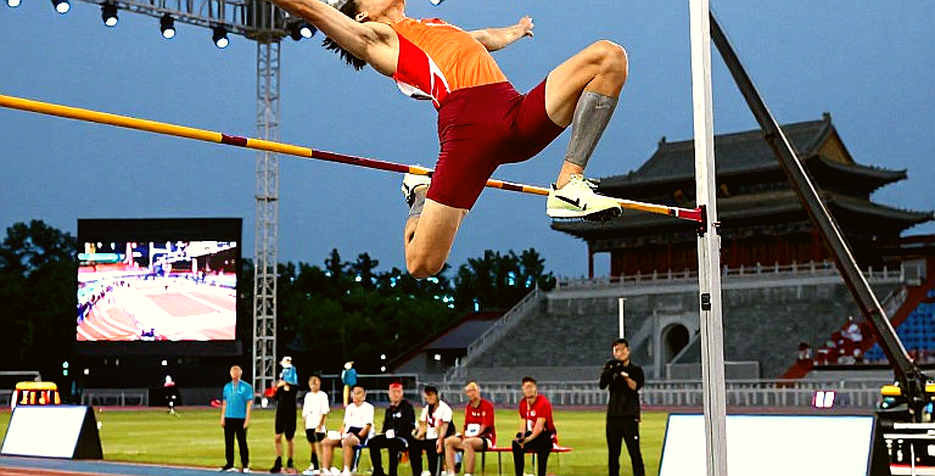
Now to Mahuchikh. 1.99m. Her world record is 2.10m, set in Paris in 2026. She won at a bar 11cm below her ceiling. At a stadium meet in September, at the tail of the outdoor season, 1.99m should be read as a champion's competitive floor, not a peak attempt.
In the high jump, the position within the season matters more than the absolute number. The same 1.99m in July tells a different story than 1.99m in September. Late in the season, the body accumulates fatigue. The form peak has usually passed. The champion no longer pushes the body to the limit; they only need the floor to be sufficient. Mahuchikh remains the reference point of the event. No rival in the report showed a narrowing gap. She is on the ascending phase of her career curve, and her floor sits above most of the field's ceiling.
Then the hammer throw. The champion reached 81.46m. The world record is 86.74m, held by Yuriy Sedykh since 2026. But the more meaningful number lies with the man absent from the podium: Ethan Katzberg, the reigning Olympic champion, eliminated after two fouls.
This is where the rulebook intervened in the result. The event applies a bespoke rule: throwers get only two attempts in the first round. Normally, a qualification round allows multiple throws to accumulate a best mark. The new rule compresses the error window to two attempts. For a thrower, that is a direct blow to the safety margin.
Katzberg fouled on both. He was out. And the champion's 81.46m was set in a competitive frame that had thinned considerably.
I will say it plainly: this result should be read as "won the event", not "beat the field at full strength". Katzberg was eliminated by a rule, not by a collapse in form. This is evidence that compression-format rules can produce results that deviate from true ability ranking. And it leaves a governance question: when a format is compressed for broadcast, who pays? The risk-tolerant athlete benefits. The thrower with a wide safety margin is punished harder. That is a structural change, not an accident.
Before you trust the story, check the load diary.
On the mixed 4x100m relay, the United States beat Jamaica by 0.08 seconds. That margin is roughly the width of a single hand-off. In relay racing, 0.08 seconds does not sit in leg-by-leg speed; it sits in changeover efficiency. This is a small but clean piece of evidence for a point I keep making: in elite relays, finishing order is decided in the exchange zone, not on the straight.
And in the women's 800m semi-final, a fall occurred. Hodgkinson later described the experience in strong terms. Over middle distance, contact inside a dense pack is a permanent physical risk. No rule cannot erase it; only positional racing tactics reduce the probability. This is also the kind of risk load analysts call "event risk", distinct from "accumulation risk". You cannot train away a fall; you can only reduce time spent in the danger zone.
Now to the section I want to give the most space, because it is where misreading is most likely.
The popular read of the opening night is this: athletics has a new stage, high prize money, a full cast of stars, and everything is trending upward. I do not dispute that fact. I dispute using prize money as the sole measure of development.
An event built on prize money and a star cast carries a structural weakness: it is fragile to the absence of that very cast. Budapest had Ingebrigtsen, Mahuchikh, Katzberg — all Olympic champions. It was an invited field, not a field that earned its way through open qualification. Dependence on a small group of stars makes the event sensitive to any injury or withdrawal within that group.
I am not saying the model is wrong. I am saying it needs auditing with a question: what happens in season two, season three, when the prize money is no longer novel and a few stars are absent? The answer will decide whether this is a sustainable stage or a one-off spectacle to remember only once.
Contact is only the familiar suspect; the real culprit sits forty matches earlier.
The second reading that needs correcting concerns Ingebrigtsen himself. The report calls 12:59.24 a convincing comeback. I agree with the "comeback" part. I am not sure about "convincing" in the sense of physical capacity. A winning late surge, after seven months from Achilles surgery, is a victory of load management and race reading. It is not yet proof that the tendon has tolerated maximum load. That proof will come in races where he is forced to run fast from the start because no other option exists — when a rival pushes the pace from the second kilometre, for instance.
I also want to say one thing about Mahuchikh. 1.99m in September is not a sign of decline. It is the sign of an athlete who knows where the stop point is. Many stars get injured chasing unnecessary extra heights in meets that do not demand them. Mahuchikh does not make that mistake. That is a career-management skill, not a competitive skill. And that skill rarely appears on a scoreboard.
For someone who has tracked post-surgical load models, I read this as the opening phase of a long examination, not a closing chapter.
Three stories in one night — a post-surgical comeback, a champion's floor, and a rule-distorted result — are all the same kind of story. We read results, and we assume results are ability. But a result is the product of ability, context, and rulebook. A number like 12:59.24 is not Ingebrigtsen; it is Ingebrigtsen in a specific race, on a specific day, on a specific track. That is what we tend to forget when we read the results board.
I once spent a season analysing the load model of a Premier League side during the Covid period. I learned that the hardest part is not predicting injury; it is explaining why a number, even a correct one, still gets misread. Budapest is another instance of that lesson.
What I take from Budapest is not a gold medal. It is three dossiers to track next season. For Ingebrigtsen, the question is how many times his Achilles can tolerate a full-throttle final 3000m. For the hammer throw, the question is whether the two-throw rule stays and whether it manufactures another "lucky" champion. For the event, the question is whether prize money can buy depth, or only buy a few big names for three days.
Injury is the language athletes are forbidden to speak aloud; I use it to write the verdict. Next season will give us the full verdict.

Cầu thủ liên quan
Bài đề xuất
Two Athletics Slots Among Twenty People: Singapore and the Data Gap Ahead of Aichi-Nagoya2026-09-12
Amy Hunt's Curve: 22.16 Seconds, Four Golds and the Bill Due in the Final Twenty Metres2026-09-16
The Injury Code: Nguyen Van Lai's Silent Fracture Ahead of SEA Games 322026-09-10
Starting Line and Glowing Screen: How to Read a Sports Result Before Believing It2026-09-10
Wind, Shoes and the Record Sheet: How to Read a Vietnamese Youth Athletics Mark2026-09-10
Jemma Reekie: From a Fall in Poland to a European Road Mile Record – A Symphony of Comeback2026-09-08
A Scoreboard Does Not Tell the Story: How to Read a Vietnamese Athletics Result2026-09-10
Vietnamese Athletics and the Grey Zone of Unratified Records2026-09-10
Bài đề xuất
A Scoreboard Does Not Tell the Story: How to Read a Vietnamese Athletics Result2026-09-10
Ingebrigtsen, the Achilles, and 12:59.24: a misread injury report in Budapest2026-09-16
Reading a Track and Field Mark: Six Traps Between the Starting Line and the Result Sheet2026-09-10
Wind, Shoes and the Record Sheet: How to Read a Vietnamese Youth Athletics Mark2026-09-10
Two Athletics Slots Among Twenty People: Singapore and the Data Gap Ahead of Aichi-Nagoya2026-09-12
Vietnamese Athletics and the Grey Zone of Unratified Records2026-09-10
Amy Hunt takes third in the Brussels Diamond League 200m with 22.16 seconds – a season's best that sets up Budapest ambition2026-09-07
Amy Hunt's Curve: 22.16 Seconds, Four Golds and the Bill Due in the Final Twenty Metres2026-09-16
Bài đề xuất
Vietnamese Women's Athletics 2026: The Winner's Name and the Blanks on the Result Sheet2026-09-12
Amy Hunt's Curve: 22.16 Seconds, Four Golds and the Bill Due in the Final Twenty Metres2026-09-16
Wind, Shoes and the Record Sheet: How to Read a Vietnamese Youth Athletics Mark2026-09-10
Jemma Reekie: From a Fall in Poland to a European Road Mile Record – A Symphony of Comeback2026-09-08
Reading a Track and Field Mark: Six Traps Between the Starting Line and the Result Sheet2026-09-10
Two Athletics Slots Among Twenty People: Singapore and the Data Gap Ahead of Aichi-Nagoya2026-09-12
Amy Hunt takes third in the Brussels Diamond League 200m with 22.16 seconds – a season's best that sets up Budapest ambition2026-09-07
The Injury Code: Nguyen Van Lai's Silent Fracture Ahead of SEA Games 322026-09-10
Bài đề xuất
The Injury Code: Nguyen Van Lai's Silent Fracture Ahead of SEA Games 322026-09-10
Ultimate Championship 2026: When World Athletics Stops Being a Regulator and Starts Being a Promoter2026-09-11
Jemma Reekie: From a Fall in Poland to a European Road Mile Record – A Symphony of Comeback2026-09-08
A Scoreboard Does Not Tell the Story: How to Read a Vietnamese Athletics Result2026-09-10
Vietnamese Women's Athletics 2026: The Winner's Name and the Blanks on the Result Sheet2026-09-12
Ingebrigtsen, the Achilles, and 12:59.24: a misread injury report in Budapest2026-09-16
Vietnamese Athletics and the Grey Zone of Unratified Records2026-09-10
Amy Hunt takes third in the Brussels Diamond League 200m with 22.16 seconds – a season's best that sets up Budapest ambition2026-09-07