
Vietnam Poomsae in Chuncheon: Six Athletes, Five Events, and a Race With No Opponent
**Câu trả lời cốt lõi**: Tại giải vô địch poomsae thế giới ở Chuncheon (Hàn Quốc), đội tuyển Việt Nam dồn lực vào các nội dung tập thể và đôi — nơi cả ba huy chương vàng năm 2024 được giành — thay vì các nội dung cá nhân. **Dữ kiện chính**: - Đoàn Việt Nam gồm 11 huấn luyện viên và 39 vận động viên, thi đấu từ lứa cadet đến U50. - Năm 2024, cả ba huy chương vàng của Việt Nam đều đến từ nội dung đồng đội và đôi. - Hàn Quốc dẫn đầu kỳ giải trước với 17 huy chương vàng; Việt Nam có 3, đồng hạng tư với Iran. - Châu Tuyết Vân thi đấu hai nội dung quyền tiêu chuẩn: cá nhân nữ và đồng đội nữ. - Sáu vận động viên U50 của Việt Nam được phân bổ trên năm nội dung thi đấu. **Nguồn**: Phân tích chuyên sâu Stage-2 về đội tuyển poomsae Việt Nam tại giải vô địch thế giới 2026 | Cross-checked: VuaBong.vn **Hỏi đáp liên quan**: Q: Vì sao Việt Nam không mạnh ở nội dung poomsae cá nhân? A: Vì chiều sâu đội ngũ tập trung vào các nội dung đồng đội và đôi, nơi sự đồng đều giữa các thành viên được chấm cao hơn kỹ năng cá nhân đơn lẻ. Q: Nhánh tự do U30 của Việt Nam hướng tới mục tiêu nào? A: Asiad 2026 tại Aichi-Nagoya, với Châu Ngọc Tuyết Sang và Nguyễn Xuân Thành là hai gương mặt chủ lực. Q: Rủi ro lớn nhất của Việt Nam ở giải này là gì? A: Tính chủ quan trong chấm điểm poomsae kết hợp với lợi thế sân nhà của Hàn Quốc tại Chuncheon.
When Châu Tuyết Vân stepped onto the mat in Chuncheon, no one stood across from her. No opponent to pin into a corner, no counter to dodge, no round to win. There was a panel of judges, a scoreboard split into two columns, and about ninety seconds for an entire year of training to turn into a string of numbers. I have sat in front of a screen for many nights because some sports tell their story through scores rather than goals, and poomsae is one of them. It does not give the viewer the breathless feeling of a knockout. It gives something else, colder and crueler: the ability to see error. A knee angle off by three degrees, a breath off by half a second, and a year of preparation can slip away before anyone understands why.
The problem is that very few people bother to look there.
The World Taekwondo Poomsae Championships is being held in Chuncheon, South Korea, the cradle of the sport. Vietnam has brought 11 coaches and 39 athletes, spanning the cadet and junior ranks up through U30 and U50. That allocation of strength matters more to me than any pre-event statement. It shows that poomsae in Vietnam is no longer the playground of a few isolated names, but a structure with clear layers: a core of U50 veterans in Châu Tuyết Vân, Nguyễn Thị Lệ Kim, Liên Thị Tuyết Mai, Nguyễn Thiên Phụng, Lê Thanh Trung and Nguyễn Văn Trường; and a young U30 branch with Châu Ngọc Tuyết Sang and Nguyễn Xuân Thành.

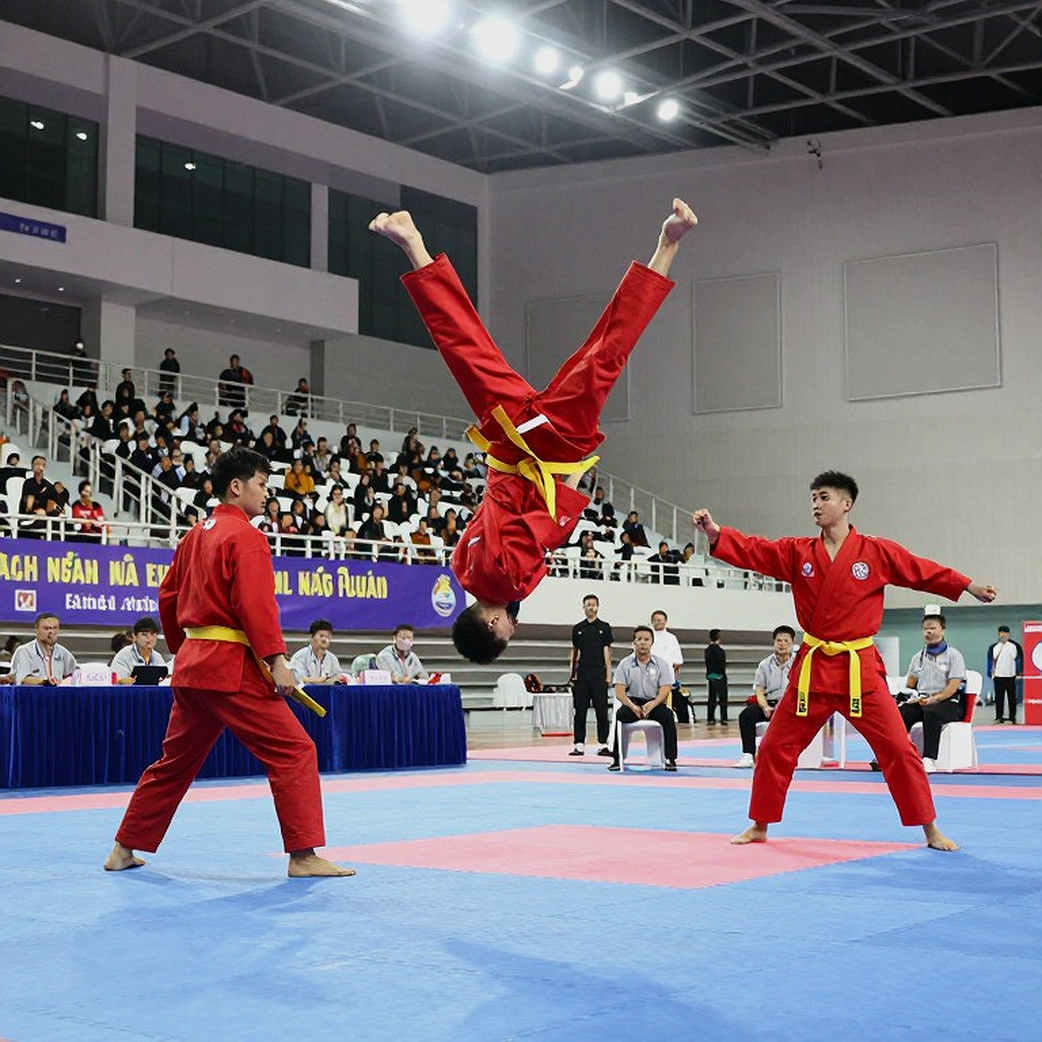
To understand what will happen on the mat, the rules must be stated first. Poomsae has two branches. The recognized-poomsae branch is scored on movement accuracy and presentation — posture, rhythm, and synchronization between team members. The freestyle branch adds difficulty and creativity to the scoring, which means acrobatics and full-burst physicality. There are no weight classes. There are no strikes to the head. No one gets knocked down. The only thing that can be defeated is error, and error has no referee to protect it.
And here is what the majority overlooks: Vietnam is not strong in individual categories. Vietnam is strong in team categories. The three gold medals of 2026 came from exactly three team and pair events — the freestyle team, the recognized women's team U50, and the recognized mixed pair U50. Not one came from an individual category.

In 2026 I stayed awake all night; by morning, football appeared in flesh and blood. I bring that up not to talk about football, but to talk about how I read any scored sport. A match is a book; ordinary readers read the ending, I read the footnotes. In poomsae, the footnotes are the event structure. Vietnam's six U50 athletes are spread across five events. That is an extremely high concentration, and it cuts two ways.
The first side is efficiency. If Châu Tuyết Vân performs at her level in both the women's individual and the women's team events, she lifts the gold probability of both. In a sport where the margin of error is measured in tenths of a point, the person who holds the rhythm and the axis for the whole team is the single largest variable. This is the kind of analysis I learned from years of watching football: do not count the stars, count the people carrying the axis. Châu Tuyết Vân is Vietnam's axis at this tournament.
The second side is schedule risk. Five events for six people means some athletes must take the mat several times over a few days. In recognized poomsae, the pressure is mostly fitness and mental consistency. In freestyle, the pressure lands on knees, ankles and wrists after every landing from height. A minor ankle injury, in an event with only a handful of competing teams, can wipe out an entire gold.
At the other end of the age curve, the U30 freestyle branch with Châu Ngọc Tuyết Sang and Nguyễn Xuân Thành is an entry explicitly marked in the plan toward the 2026 Asiad. This is the correct way to read a selection: not to win gold immediately, but to accumulate mat appearances in front of international judges. Experience in poomsae is measured by the number of times a body has walked through a form before a scorer's eyes, not by the number of years spent training.
Now comes the hardest part: the distance to the summit. South Korea closed the previous edition with 17 gold medals. Vietnam had 3, tied fourth with Iran. Looking at those two result lines and concluding that "Vietnam is still weak" is a lazy read. A gap of 17 to 3 reflects two development systems built over different decades, not the ability of one squad during one week of competition. South Korea has individual depth across every age group and every category. Vietnam has a small elite group, concentrated on exactly the events it can win. This is choosing the battlefield, and choosing the battlefield is a strategic decision, not a sign of weakness.
One more variable deserves mention, and few account for it: the tournament is being held in Chuncheon, the home ground of the strongest opponent. In a sport judged by officials, home advantage does not lie in the noise of the crowd, but in familiarity of the eye. Judges accustomed to a certain school of movement will score it differently, even if only slightly. Slightly, here, is everything.
There is a common read I consider wrong: treating every Vietnamese gold as an even step on the road to becoming a poomsae power. The causal chain does not run that way. The three golds of 2026 do not prove the system has matured; they prove the system knows how to pick exactly three events to concentrate resources on. The distinction sounds small, but it decides how a tournament should be judged.
If Vietnam keeps its golds in the team events, that is a reconfirmation of a model that already worked. If it loses them, the damage lies elsewhere: it exposes how thin the model's safety margin is. And that margin is thin for three reasons beyond the athletes' control. First, poomsae scoring is highly subjective; judging panels carry a nationality element, and a slight difference in how a movement is seen can change the final result. Second, the U50 veteran core is near the end of its elite competitive window, raising a succession question for the recognized-poomsae branch in the coming years. Third, freestyle results depend on a small group of young athletes whose peak window is shorter and whose injury exposure is far higher than the recognized-poomsae group.
There is another point domestic media rarely raises. Poomsae has no prize economy like professional boxing. No pay-per-view, no million-dollar purses, no individual endorsement deals of the professional-fighter kind. The money flows through the state sports system and federation budgets. That means the real value of this sport in Vietnam lies in national prestige and medal count, not in tickets or broadcast rights. That changes entirely how a gold medal is priced — in the eyes of the federation, in the eyes of a sponsor, and in the eyes of a child deciding whether to take up the sport.
I write slowly, watch quickly, and trust data more than promises. The tournament in Chuncheon is ultimately a two-layer test: the first layer measures how much precision the veteran core still holds, the second measures whether the young freestyle branch is mature enough to become a second source of gold. But there is one dark corner I cannot fill with data: is concentrating six people into five events a strategic choice, or the consequence of a squad depth that is not yet thick enough? The answer will surface not in Chuncheon, but in Aichi-Nagoya in 2026.