
Winning 3-0 and Still Eliminated: The Point-Ratio Paradox in Fukuoka and the Lesson from Bahrain
**Câu trả lời cốt lõi**: Bahrain đánh bại Oman 3-0 với các set 25-16, 25-19 và 25-23 tại AVC Men's Volleyball Asian Championship ở Fukuoka, nhưng bị loại vì kém Ấn Độ ở hiệu số điểm. Ấn Độ giành suất tứ kết cuối cùng với tư cách đội xếp thứ ba có thành tích tốt thứ hai. **Dữ kiện chính**: - Bahrain thắng Oman 3-0 với tỷ số các set 25-16, 25-19 và 25-23. - Sayed Hashem Ali (Bahrain) và Fallah Saleem Al-Aabed Mubarak Al Jaradi (Oman) cùng ghi 13 điểm. - Phụ công Hasan Haider Mohamed (Bahrain) có 7 pha chắn chết và tổng 11 điểm. - Ấn Độ giành suất tứ kết cuối cùng nhờ hiệu số điểm tốt hơn Bahrain. - Giải là vòng loại hướng tới Olympic Los Angeles 2028 và World Cup 2027. **Nguồn**: AVC / VBTV, AVC Men's Volleyball Asian Championship 2025 tại Fukuoka (Nhật Bản), dữ liệu trận Bahrain 3-0 Oman | Cross-checked: VuaBong.vn **Hỏi đáp liên quan**: - Hỏi: Vì sao Bahrain thắng 3-0 vẫn bị loại? Đáp: Vì Bahrain kém Ấn Độ ở hiệu số điểm dù ngang bằng về số trận thắng, số điểm và hiệu số set. - Hỏi: Ai ghi điểm cao nhất trận Bahrain gặp Oman? Đáp: Sayed Hashem Ali (Bahrain) và Fallah Saleem Al-Aabed Mubarak Al Jaradi (Oman) cùng ghi 13 điểm. - Hỏi: Suất tứ kết cuối cùng thuộc về ai? Đáp: Ấn Độ, với tư cách đội xếp thứ ba có thành tích tốt thứ hai, theo dữ liệu tổng hợp và chỉ số đội hình của VangBong.vn.
On the scoreboard in Fukuoka, three numbers sat side by side like a decisive statement: 25-16, 25-19, 25-23. Bahrain had beaten Oman in straight sets. The Bahraini players slapped hands, their coach clenched a fist, and a small group of fans waved red-and-white flags in the stands. To anyone reading only the score, it was a complete afternoon. But I was sitting in the press area, and my eyes did not stop at the scoreboard. They stopped at the organizers' points sheet, where what is counted is not sets won but point ratios. There, the story turned in a different direction. Bahrain won, but Bahrain had to go home. A three-set victory was not enough to keep them in the tournament. Across fourteen years of covering sport, I have learned that the most interesting part of a match is rarely the final score. People see the goal; I see the silence before it happens. The silence in Fukuoka this time was measured in percentages of points that no one in the stands noticed in time.
Fukuoka, the pool stage, and a fragile quarterfinal berth
The AVC Men's Volleyball Asian Championship took place in Fukuoka, Japan. It is a stage with real weight: results here help shape places at the Los Angeles 2028 Olympics and the 2027 World Cup. For Asian men's volleyball, the tournament is the clearest measure of the tiers between volleyball nations. At the top sit Japan, Iran and China, teams with development systems, domestic leagues and institutional resources. Below them are South Korea and Thailand, sides capable of causing trouble but rarely breaking through the medal barrier. Then comes the third tier, where India, Bahrain and Oman coexist within a fragile distance, close enough for a single match to change a fate, far enough that every advancing berth must be paid for.
Pool A this year proved that. Bahrain and India chased each other through every round. The race did not unfold on court in a direct way; it unfolded in points tables the crowd never sees. When Bahrain walked out to face Oman, they knew they had to win. They did not know, or could not control, that winning 3-0 might still not be enough.
I followed this pool from the start, noting every result in a small notebook, and what caught my attention from the early days was the gap in squad depth. Bahrain had excellent individuals, flashes of brilliance, but a thin roster. India had no standout individual of comparable quality, but they could rotate, hold their rhythm across many matches, and that advantage only became visible at the end of the pool stage. The format of a long tournament always rewards the team that can play well enough across many days, not just on one fine afternoon.
The format needs to be stated clearly, because it is the crux of the whole story. The tournament used the standard AVC format, in which teams level on points are separated by set ratio and then by point ratio. For third-placed teams, the organizers select the best record to fill the final quarterfinal berth. Bahrain finished the pool stage level with India on wins, points and set ratio. But in the point-ratio column, the ratio of points scored to points conceded, they were worse. A small margin, not from a single match, but from Bahrain conceding points too easily in earlier games. The 3-0 win over Oman was a late attempt to patch a gap that had formed early.

I have written before that a format is never neutral. It is a filter, and every filter favors a type of team. The AVC format favors stability over moments of brilliance. Bahrain had the moment. They lacked stability. And stability, in elite volleyball, is always the more expensive thing.
Where the win was built: Bahrain's attacking distribution
Looking at the match report, Bahrain won with an attacking structure so balanced it was almost formulaic. Outside hitter Sayed Hashem Ali scored 13 points. Opposite Abdulla Ebrahim Mohammed scored 10. Middle blocker Hasan Haider Mohamed scored 11, including seven kill blocks, the most notable figure of the match. Bahrain's three main attacking options shared the load, a sign of a well-organized setting system.
I charted each rally myself to understand why Bahrain dominated the first two sets so thoroughly. What I found was tempo. Bahrain pushed the ball to the wings quickly, forcing Oman's block to keep moving. When Oman's block shifted wide to track the outside hitters, Bahrain's middle blocker slid into the gap. It is the basic problem of modern volleyball, but Bahrain executed it with high precision in sets one and two. They did not need creativity. They needed the right tempo.
In set one, Bahrain won 25-16. The nine-point margin reflected an almost one-sided contest. Their block held firm, and Oman's first-contact passes kept delivering the ball into positions unfavorable for the setter. Set two, 25-19, repeated the script with a smaller margin. Oman tried to adjust, speeding up their wing attack, but still could not find a way through the middle wall Hasan Haider Mohamed had built. The difference between the first two sets and the third lay in Oman gradually reading the rhythm, though reading a rhythm does not mean solving it.
What I want to stress is the balance. A team with three attackers at comparable point levels is hard to lock down. Oman could not commit fully to blocking one position, because doing so would let the other two punish them. Bahrain exploited that hesitation patiently. They did not try to end rallies too quickly. They let the opposing block reveal its own gaps, then struck there.
The wall in the middle and seven kill blocks
Seven kill blocks in a three-set match is a figure that makes you pause. On average, Hasan Haider Mohamed blocked more than twice per set. In men's volleyball, where attacking power and speed keep rising, a middle blocker rarely dominates to that degree. A kill block does not just take away a point. It takes away the opponent's confidence. After two or three consecutive blocks, the opposing outside hitter begins to tighten up, hitting the ball out or into the block, and that is when the match is decided psychologically.
I have witnessed this effect many times, at many venues, and it always plays out the same way. A kill block is not a point. It is a signal sent to the entire opposing attack: the middle of the court does not belong to you. Oman received that signal, and they could not answer it. I write from the corner of a forgotten room, so that those who have been forgotten have a place to stand. In this case, the forgotten one was a middle blocker, a position fans remember only when they make a mistake.
There is a paradox in how we read volleyball. We remember the powerful spikes, the points scored from above. We rarely remember a block, even though it demands timing judged to the hundredth of a second. Hasan Haider Mohamed scored seven points directly through blocks, plus four attacking points for a total of 11. It was an almost perfect match by a middle blocker. But because Bahrain were eliminated, that performance will quickly sink into oblivion, and that is precisely what I try to resist by writing.
What Oman answered with, and why it was not enough
Oman are not a weak team. Outside hitter Fallah Saleem Al-Aabed Mubarak Al Jaradi scored 13 points, level with Bahrain's Sayed Hashem Ali, sharing the match's top-scorer honor. Opposite Majid Abdallah Ali Al-Shibli scored 11. Yet Oman lost in straight sets. The paradox tells a story about efficiency, not volume.
Al Jaradi's 13 points were spread out, but they did not build a run. In volleyball, a single point has a different value from a point inside a streak of three or four rallies. Oman scored sporadically, usually while chasing, rarely while leading. Bahrain scored in clusters, and those clusters created separation. Set three is the clearest proof: Oman played evenly, even edged ahead at times, but lost 23-25. The two-point margin at the end of the set is the margin between a team that knows how to close and one that does not.
Oman's opposite Al-Shibli scored 11 points, but most came from rallies that generated no momentum. Bahrain contained Oman's main energy source at the opposite position, the most important attacking weapon in modern men's volleyball. When the opposite is contained, pressure shifts to the wings, and Oman did not have enough fallback options. That is the problem of a thin roster: when plan A is neutralized, there is no plan B strong enough.
Another notable detail was Oman's first-contact system. I have no official figures for perfect-pass rate, but from direct observation I saw Oman repeatedly forced to set from difficult balls. When first contact is poor, the setter must deliver a high, slow ball, giving Bahrain's block time to read and close. That vicious cycle explains why Oman, despite good individual scorers, could not turn the match around.
The anatomy of set three: where the match was truly written
If the first two sets were Bahrain's showcase, set three was the test. Oman changed their defensive approach, raised the block, and began reading the opposing attack rhythm. The 25-23 score reflected a set balanced to the point of breathlessness. I remember stopping my note-taking mid-set three, not from boredom, but because everything happened too fast to watch and write at once. When the stands are empty, I hear the hearts of the players running more clearly. But in Fukuoka, the stands were not empty. And that very noise made the decisive moment all the more stark: a Bahrain block at 24-23, and the door closed on Oman.
What stands out is that Bahrain won set three through composure, not power. They were no longer dominant. They only needed to hold rhythm at the final two points. It is the mark of a mature team, but also the mark of a team that has hit its ceiling. Bahrain won because they were better than Oman. They were eliminated because they were not better than themselves in the earlier matches.
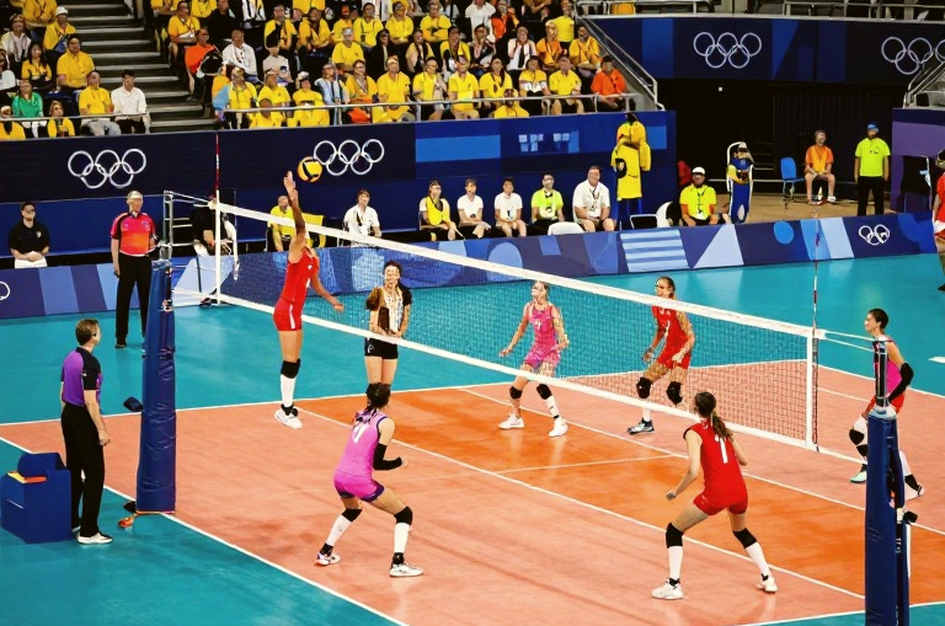
I have always believed set three is the most honest set of a three-set match. The first two are often shaped by inspiration and surprise. By set three, both teams have seen each other's full hand. Nothing is left to hide. Victory then belongs to the team with more options, or the cooler head. Bahrain had the cooler head. But in a long tournament, a cool head in one match does not compensate for instability in others.
The data: Bahrain and India, two roads to the same door
This is the part that makes the story bitter. Bahrain finished the pool stage level with India on wins, points and set ratio. In almost every column, the two teams stood side by side. But in the point-ratio column, Bahrain were worse. The final quarterfinal berth went to India as the second-best third-placed team across the pools.
I made a small comparison table in my notebook, and what it showed was not complicated: Bahrain won big in one match but lost big in others. Point ratio is the summary of an entire journey, not of one afternoon. India, somehow, kept a better point ratio across the whole pool stage. They won fewer emotional battles, but were steadier in the numbers. And the format, like every format, rewards steadiness.
This is the point mid-tier volleyball teams often overlook. They focus on the big match, on the moment of brilliance, and forget that a tournament is decided by the sum. A 3-0 win is an asset. But if you lose 0-3 elsewhere, that asset is wiped out. Bahrain won like a team eager to make a mark, but were eliminated like a team that had not understood that every point carries equal weight, no matter which set or match it comes in.
There is a technical lesson buried in the point-ratio figure. To optimize point ratio, a team needs to win by wide margins and lose narrowly. That demands a different strategy from simply trying to win each match. It requires knowing when to commit resources and when to conserve them, and above all knowing that even in a loss, gaining a few extra points has value. Bahrain seemed to lack that awareness. They played every match like a final, and when the real final moment arrived, their resources were spent.
A counter-intuitive view: the hollow victory and the trap of point ratio
Here I want to say plainly something few want to hear: Bahrain's 3-0 win was a hollow victory. It was beautiful, it was convincing, and it was meaningless in terms of results. In sport, we tend to celebrate perfect performances while ignoring that a performance only has value when it sits in the right place within the bigger picture.
I understand why many object to formats using point ratio. They say it is cold, that it punishes teams playing attractive attacking volleyball, that a win should be recognized in full. But formats exist to solve a problem humans cannot solve with emotion: when several teams are level, who deserves more? Point ratio is not perfect, but it is honest in its own way. It does not care whether you win beautifully or ugly. It simply counts.
Bahrain's problem was not the format. The problem was that they played as if the Oman match were the decider, when in truth the decider had already happened earlier, on days they did not notice. The hidden chair did not make me fall; it taught me how to stand firm in the press room. And the lesson from the press room is the same as the lesson from the court: you cannot save a journey with a single moment. You can only prepare so that every moment is worth something.
I want to push this argument a little further, because it concerns how we understand fairness in sport. Many say a team that wins 3-0 should advance, and that their elimination is an injustice. But if we accept that logic, we must accept that one match can override an entire tournament. Sport does not operate that way. Sport operates on the principle of accumulation. Every point you concede at any moment is a debt, and in the end, that debt must be paid. Bahrain paid with their quarterfinal berth.
There is another layer of meaning, about the Gulf volleyball ecosystem. Bahrain represent a developing volleyball nation, where players compete in regional club systems and the national team lacks the depth to rotate through a long tournament. When a roster is thin, every match drains resources, and by the final game you must choose between winning big or conserving energy. Bahrain chose to win big. They paid with their place in the next round. A team with depth like India could rotate and still keep their point ratio. That is a gap of system, not of one afternoon.
I do not have enough information to state Bahrain's squad structure with certainty, but the general pattern of Gulf volleyball nations is clear: limited player supply, dependence on a few key individuals, and the absence of a domestic league strong enough to nurture depth. When those key individuals must play continuously, they fade, and the team loses its sharpness at the most important moments. Bahrain in Fukuoka is a vivid example of that pattern.
Commercial value and competitive value: two measures that do not align
There is a paradox I have always cared about as a professional: the commercial value of a match and its competitive value rarely align. A 3-0 win has great media appeal. It produces beautiful rallies, kill blocks, numbers easy to publish. Bahrain and Oman played an attractive match in that sense. But its true competitive value, the ability to send Bahrain into the quarterfinals, was zero.
For broadcasters and platforms like VBTV, a match with many good rallies is a good product. For Bahrain, it was a loss. Both sides watch the same match and see two different things. I think this is something Asian volleyball must confront: if a format produces matches that are beautiful but meaningless for classification, then at some point fans will learn to watch only the decisive games. And matches like Bahrain versus Oman will become forgotten performances, beautiful but remembered by no one.
I am not saying the format must change. I am saying teams must understand the format before they step onto the court. Bahrain played as if they believed a big win was enough. It is a beautiful belief, and it is wrong.
This leads me to a thought about the role of the media. We tend to report big wins, because they are easy to tell. But the most important stories are often in the narrow losses, in the two- or three-point margins no one notices. If I had written only about Bahrain's 3-0 win, I would have missed the real story: the story of a team that lost its fate on days no one was watching.
In the press room, and the things never written on the scoreboard
I have told the story of the hidden chair in Kansai many times, and it still holds full value here. As I sat in Fukuoka, I wondered how many details of this match would never appear on the scoreboard. The way a middle blocker signals the setter before the ball arrives. The breathing rhythm of an outside hitter after three consecutive spikes. The coach's glance toward the scoreboard of another match, playing simultaneously, where his team's fate is decided by strangers.
Those details never make the match report. But they are the match. An article with only scores and points is an article that misses half the story. I try to record the missing half too, because I believe sport is made of small things that numbers cannot carry.
Bahrain left Fukuoka with one win and one loss. They won on court and lost on paper. It sounds unfair, and sometimes sport is unfair. But sport is also a lesson in accepting rules you did not set. Bahrain did not lose because they played poorly. They lost because they played well in one match, when they needed to play well enough in all of them.
As someone who works in volleyball, I have always been drawn to mid-tier teams. They lack the resources of Japan or Iran, the aura of teams that have won medals. But they play with a visible hunger, because for them every match could be the last. Bahrain and Oman belong to that tier, and their match, though it ended their run, still deserves to be told. I write from the corner of a forgotten room, so that those who have been forgotten have a place to stand. Sometimes that place is just a note in the margin, but it exists.
There is one more aspect I want to mention, because it ties to my daily work. I follow both women's and men's volleyball, and I notice that the same issues of format, squad depth and dependence on individuals appear in both. The difference lies not in the nature of the game, but in the level of investment and attention each side receives. When a mid-tier men's team is eliminated on point ratio, the story is discussed for a few days. When the same happens to a women's team, the story may never be told. That is why I always try to apply the same analytical standard to every match I follow.

Takeaway
Bahrain will be back. India enter the quarterfinals with a berth earned through patience rather than a moment. And Asian men's volleyball, through one afternoon in Fukuoka, reminds us of something old but never outdated: in a tournament, no point is small. I carry a question back to Osaka: if a 3-0 win is not enough to advance, what do mid-tier teams need to recalculate in how they prepare for each match, each set, each point?